# The Dodo Digest: Usage pricing makes users calculate. Credits make them commit.
> Learn why credit-based billing outperforms pure usage pricing for AI SaaS, with practical setup steps and key v1.86.0 updates from Dodo Payments.
- **Author**: Rishabh Goel
- **Published**: 2026-03-05
- **Category**: Newsletter
- **URL**: https://dodopayments.com/blogs/en/newsletter-mar5
---
**TL;DR:**
AI demand is unpredictable. Pure usage billing means you absorb infrastructure spikes upfront and collect revenue later, carrying both scaling and postpayment risk.
Credit-based billing changes that. Customers pay upfront, usage is funded, risk drops, and pricing becomes more predictable.
With the latest launch of CBB, Dodo Payments makes this easy to implement, create credits, attach them to products, link them to usage meters for auto-deduction, and manage rollover, overage, and expiry, all built in.
Check out our Demo video - [YouTube](https://youtu.be/4RR3Yj3Qeuw)
**Hello everyone,**
I was using Claude the other day and ran out of usage mid work, even though I thought I had enough capacity left. That moment hit me, every time you use most AI tools, you start subconsciously calculating cost versus value, checking usage, and guarding against surprises.
That's when it clicked:
**Usage pricing makes users calculate. Credits make them commit.**
Pure usage pricing works in certain situations. Customers like paying only for what they consume. There's no upfront commitment. It reduces friction to getting started. And if usage is highly variable, it feels fair.
But AI products are different.
We've all seen it. [Claude went down](https://www.reddit.com/r/ClaudeAI/comments/1rir4n5/claude_is_down/) twice within a few hours recently. It wasn't just an outage story, it was a reminder of how unpredictable AI demand can be.
If you're billing purely on usage, you have to scale your infrastructure immediately to handle that demand. Your costs increase in real time, but you only collect payment at the end of the billing cycle.
That means you're carrying two major risks at once: scaling risk and payment risk. You absorb the higher compute costs first, and you hope the payment goes through later. If a charge fails after heavy usage, you're left covering the gap. A credit system doesn't prevent outages or demand spikes, but it does reduce the financial exposure. Customers pay before they consume. So if usage grows suddenly, it's already funded.
A credit system flips that dynamic.
 ## You get paid before usage happens
With traditional usage billing, you provide value all month and collect payment at the end. With credits, customers prepay. Revenue is recognized upfront.
For early-stage AI companies especially, this improves cash flow immediately. You're funded before heavy compute costs are incurred. That means you can scale infrastructure, pay model providers, and grow without waiting 30-60 days for collections.
## You eliminate payment failures and billing disputes
One of the worst SaaS scenarios: a customer racks up large usage, the card fails at month-end, and you're left covering the cost.
With credits, customers can only consume what they've already paid for. There's no surprise invoice. No failed charge after heavy usage. No debate over "unexpected consumption." Payment precedes delivery.
It protects margins.
## Customers get built-in spending control
AI costs can spiral quickly. A misconfiguration, a background job running overnight, or a sudden spike in demand can create bill shock.
Credits act as a natural spending cap. Customers see their balance in real time. They know exactly how much capacity they have left. That visibility reduces anxiety and makes your product safer to experiment with, especially for budget-conscious teams.
## Engagement actually increases
When users see their balance updating with every action, they become more intentional. They start understanding which features deliver the most value. They optimize usage patterns. They connect cost to outcome more clearly.
That awareness often leads to stronger retention and smarter expansion -- not random churn.
## You unlock flexible pricing strategies
Credits aren't just a billing unit. They're a growth tool.
- Offer larger credit packs at better rates to encourage bigger upfront purchases.
- Price premium features at higher credit costs while keeping basic ones affordable.
- Give promotional credits to new users.
- Reward referrals with bonus credits.
- Add expiration windows to encourage regular usage.
We've put this poll on our [Discord](https://discord.com/channels/1305511580854779984/1314487300645715988/1479069561247498423), head over and vote. Results in the next issue!
You gain flexibility without rebuilding your pricing structure every time. If you want to implement this in Dodo Payments, it is straightforward.
## How to set this up in Dodo Payments
You can build this in minutes.
Go to **Products -> Credits** in your dashboard and create a new credit. Give it a name. Choose whether it represents a custom unit (like tokens or API calls) or real currency. Define precision and expiry rules.
## You get paid before usage happens
With traditional usage billing, you provide value all month and collect payment at the end. With credits, customers prepay. Revenue is recognized upfront.
For early-stage AI companies especially, this improves cash flow immediately. You're funded before heavy compute costs are incurred. That means you can scale infrastructure, pay model providers, and grow without waiting 30-60 days for collections.
## You eliminate payment failures and billing disputes
One of the worst SaaS scenarios: a customer racks up large usage, the card fails at month-end, and you're left covering the cost.
With credits, customers can only consume what they've already paid for. There's no surprise invoice. No failed charge after heavy usage. No debate over "unexpected consumption." Payment precedes delivery.
It protects margins.
## Customers get built-in spending control
AI costs can spiral quickly. A misconfiguration, a background job running overnight, or a sudden spike in demand can create bill shock.
Credits act as a natural spending cap. Customers see their balance in real time. They know exactly how much capacity they have left. That visibility reduces anxiety and makes your product safer to experiment with, especially for budget-conscious teams.
## Engagement actually increases
When users see their balance updating with every action, they become more intentional. They start understanding which features deliver the most value. They optimize usage patterns. They connect cost to outcome more clearly.
That awareness often leads to stronger retention and smarter expansion -- not random churn.
## You unlock flexible pricing strategies
Credits aren't just a billing unit. They're a growth tool.
- Offer larger credit packs at better rates to encourage bigger upfront purchases.
- Price premium features at higher credit costs while keeping basic ones affordable.
- Give promotional credits to new users.
- Reward referrals with bonus credits.
- Add expiration windows to encourage regular usage.
We've put this poll on our [Discord](https://discord.com/channels/1305511580854779984/1314487300645715988/1479069561247498423), head over and vote. Results in the next issue!
You gain flexibility without rebuilding your pricing structure every time. If you want to implement this in Dodo Payments, it is straightforward.
## How to set this up in Dodo Payments
You can build this in minutes.
Go to **Products -> Credits** in your dashboard and create a new credit. Give it a name. Choose whether it represents a custom unit (like tokens or API calls) or real currency. Define precision and expiry rules.
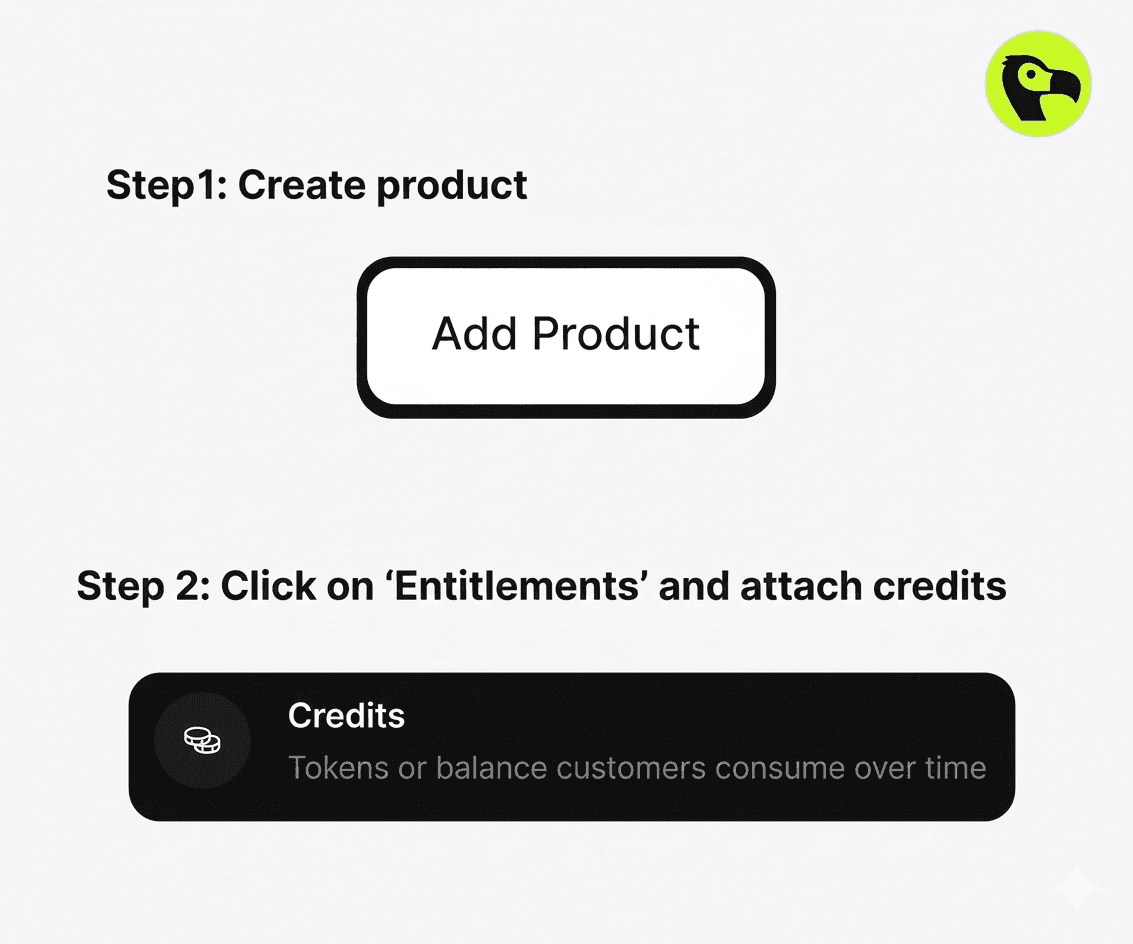 Save it. Then attach that credit to a subscription or one-time product. If needed, you can attach multiple credit entitlements to a single product.
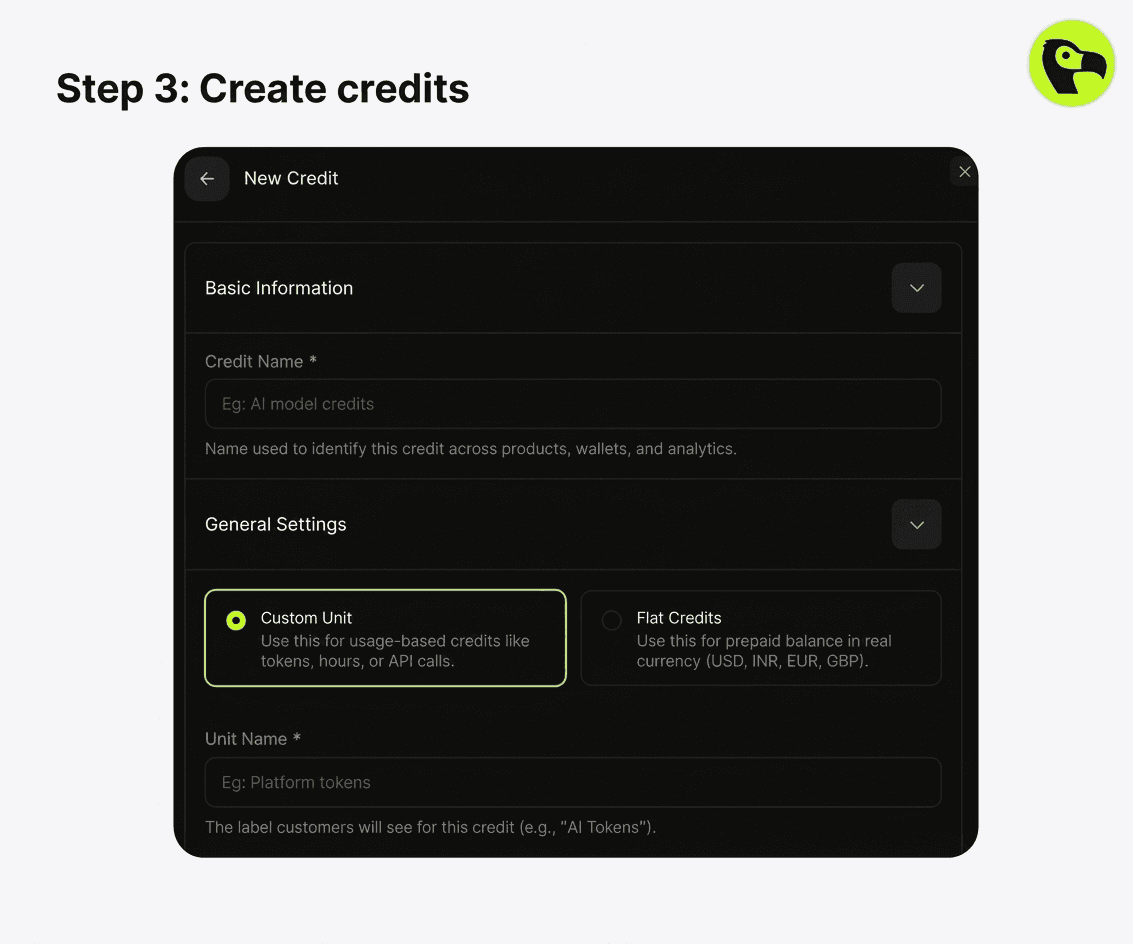 Finally, link the credit to a usage meter so deductions happen automatically as customers use your service. Their balance updates in real time, and they can see everything in the portal.
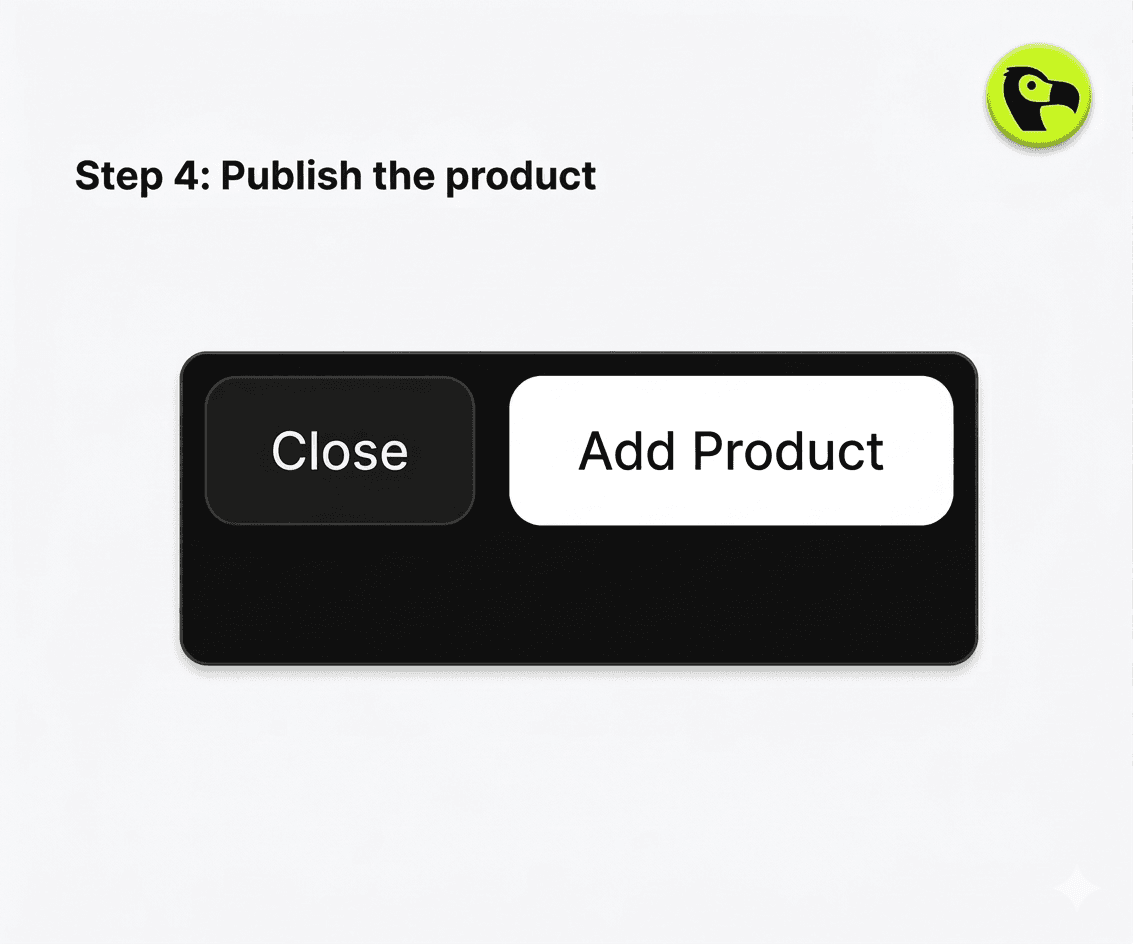 That's it. No complex workaround.
## What's new in v1.86.0
That's exactly why Dodo Payments introduced a much deeper **Credit-Based Billing system in v1.86.0**:
**Credit-Based Billing:** Dodo Payments now supports Credit-Based Billing, a flexible system to issue, manage, and track credit entitlements across subscriptions, one-time products, and usage-based billing. Instead of charging per-use or limiting access through feature flags, you allocate a pool of credits that customers draw from as they consume your service.
Beyond credits, v1.86.0 also strengthened the surrounding infrastructure:
- **Unified Design & Theme Hub:** Centralized customization across checkout, customer portal, and transactional emails. Update branding, layout, and colors from one place instead of managing scattered configuration settings.
- **Refund & Dispute Status in List Payments API:** Filter payments by refund or dispute status directly within the API, making reconciliation workflows and internal dashboards cleaner without extra endpoint calls.
- **Refunds Table in Customer Portal:** Customers can see refund history with timestamps, amounts, and statuses -- reducing support queries through self-serve visibility.
- **Copy to Live Mode for Meters:** Move test-mode meters to production in one click, preserving event schemas and aggregation logic so you don't rebuild configurations after validation.
AI demand is unpredictable. Costs rise instantly. Payments don't always. You can't control traffic spikes, but you can control when you get paid. Usage pricing lowers friction. Credits reduce risk.
If you're building in AI today, that shift matters.
Also, join our loving [Discord community](https://discord.gg/dodo-payments-1305511580854779984)!
Best,
Rishabh Goel
Co-Founder,
**Dodo Payments**
---
- [More Newsletter articles](https://dodopayments.com/blogs/category/newsletter)
- [All articles](https://dodopayments.com/blogs)
That's it. No complex workaround.
## What's new in v1.86.0
That's exactly why Dodo Payments introduced a much deeper **Credit-Based Billing system in v1.86.0**:
**Credit-Based Billing:** Dodo Payments now supports Credit-Based Billing, a flexible system to issue, manage, and track credit entitlements across subscriptions, one-time products, and usage-based billing. Instead of charging per-use or limiting access through feature flags, you allocate a pool of credits that customers draw from as they consume your service.
Beyond credits, v1.86.0 also strengthened the surrounding infrastructure:
- **Unified Design & Theme Hub:** Centralized customization across checkout, customer portal, and transactional emails. Update branding, layout, and colors from one place instead of managing scattered configuration settings.
- **Refund & Dispute Status in List Payments API:** Filter payments by refund or dispute status directly within the API, making reconciliation workflows and internal dashboards cleaner without extra endpoint calls.
- **Refunds Table in Customer Portal:** Customers can see refund history with timestamps, amounts, and statuses -- reducing support queries through self-serve visibility.
- **Copy to Live Mode for Meters:** Move test-mode meters to production in one click, preserving event schemas and aggregation logic so you don't rebuild configurations after validation.
AI demand is unpredictable. Costs rise instantly. Payments don't always. You can't control traffic spikes, but you can control when you get paid. Usage pricing lowers friction. Credits reduce risk.
If you're building in AI today, that shift matters.
Also, join our loving [Discord community](https://discord.gg/dodo-payments-1305511580854779984)!
Best,
Rishabh Goel
Co-Founder,
**Dodo Payments**
---
- [More Newsletter articles](https://dodopayments.com/blogs/category/newsletter)
- [All articles](https://dodopayments.com/blogs)